If you work at a desk — whether in an office downtown or from your home in the mountains — your body is quietly accumulating damage every single day. Eight or more hours of sitting, staring at a screen, and clicking a mouse creates a cascade of muscular dysfunction that most people don't notice until it becomes a real problem.
Asheville has become a magnet for remote workers. People move here for the mountains, the creative energy, the quality of life — but then spend their days hunched over a laptop at a kitchen table or makeshift home office. The irony is that you're surrounded by some of the most beautiful trails and scenery in the Southeast, but your body is too locked up to enjoy them.
At Zen Fox Healing Arts in West Asheville, off Brevard Road near the NC Arboretum, a significant portion of massage clients are desk workers dealing with the exact same patterns of tension. Here are five ways regular massage therapy can undo the damage — and keep it from coming back.
Why Desk Work Is So Destructive to Your Body
Before we get into the benefits, it helps to understand why sitting at a desk is so hard on your body. The issue isn't that sitting is inherently bad — it's that prolonged static posture is one of the worst things you can do to your musculoskeletal system.
When you sit for hours at a time, several things happen simultaneously:
- Your spine compresses — The intervertebral discs lose hydration and elasticity when they're under constant load without movement
- Your hip flexors shorten — The psoas and iliacus muscles lock into a shortened position, pulling your pelvis into an anterior tilt and straining your lower back
- Your chest muscles tighten — The pectorals and anterior deltoids pull your shoulders forward into a rounded posture
- Your head migrates forward — For every inch your head moves in front of your shoulders, your neck muscles have to support an additional 10 pounds of effective weight
- Your glutes deactivate — Prolonged sitting causes gluteal amnesia, forcing your lower back and hamstrings to compensate during movement
Over time, these adaptations become structural. Your fascia remodels around these positions, your muscles develop trigger points and adhesions, and your nervous system starts treating these dysfunctional patterns as normal. That's where massage therapy comes in.

1. Reverses “Tech Neck” and Forward Head Posture
The most visible consequence of desk work is what therapists call “tech neck” — a forward head posture where the chin juts ahead of the shoulders. This puts enormous strain on the muscles at the back of the neck and compresses the structures at the front.
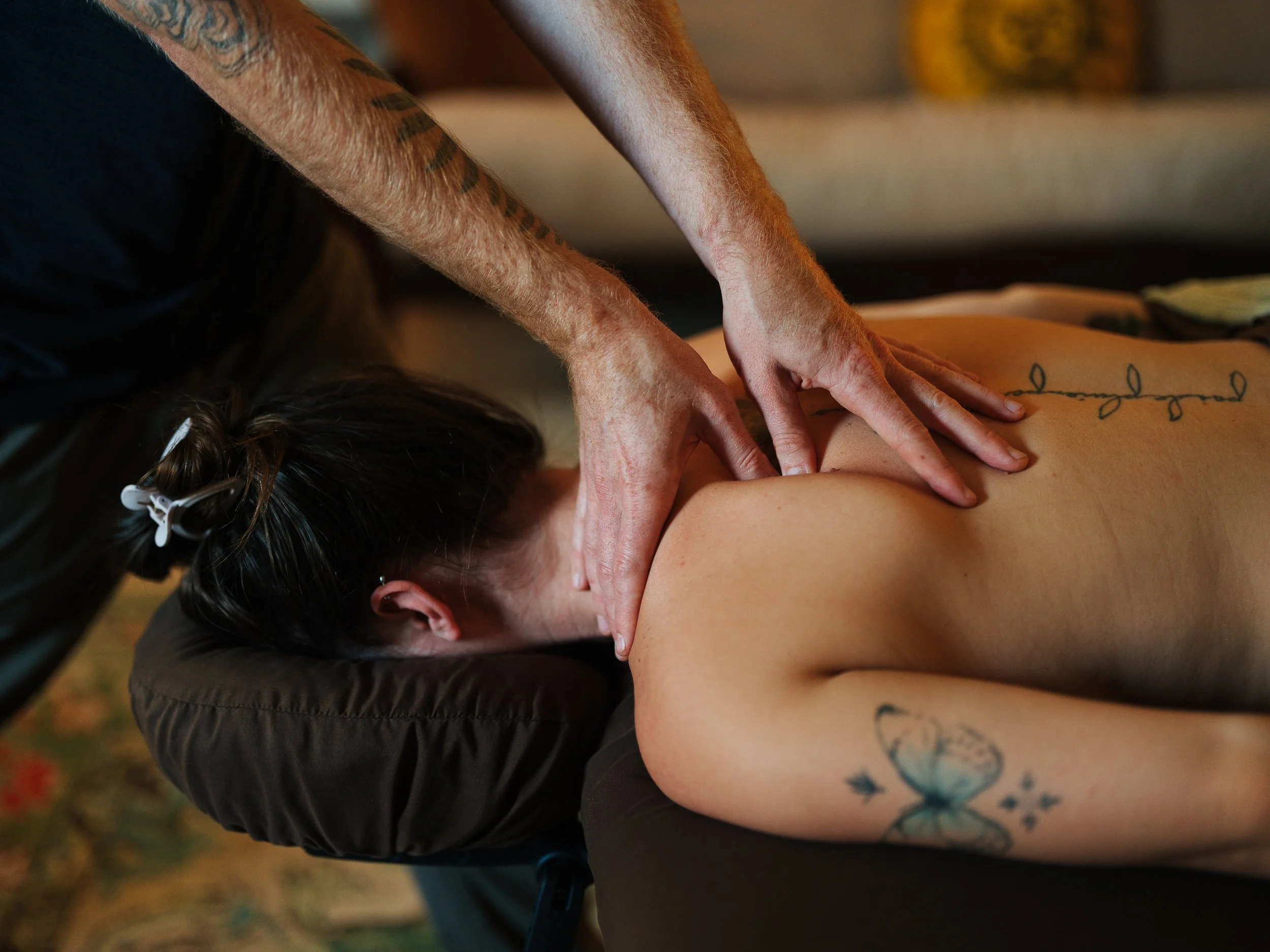
In a targeted massage session, Michael works directly on the muscles responsible for this pattern: trigger point therapy on the SCM (sternocleidomastoid), the scalenes along the side of the neck, the upper trapezius across the shoulders, and the suboccipitals at the base of the skull. These are the muscles that lock your head into that forward position.
By releasing these trigger points and restoring normal resting length to these muscles, your head naturally settles back over your shoulders where it belongs. Clients often say they feel taller after a session — and they're not imagining it. Their posture has genuinely shifted.
2. Eliminates Tension Headaches at Their Source
If you get headaches by mid-afternoon most workdays, they're almost certainly tension headaches originating from your neck and shoulders — not from your brain. Popping ibuprofen treats the symptom, not the cause. The cause is muscular.
Tension headaches are typically referred pain from trigger points in the upper trapezius, levator scapulae, and suboccipital muscles. These muscles are under constant strain when you're looking at a monitor all day, and they refer pain up into the head in predictable patterns — around the temples, behind the eyes, and across the forehead.
Myofascial release on the neck and shoulders directly addresses the source. Rather than masking the pain with medication, skilled massage therapy releases the specific muscular restrictions that are generating the headache pattern. Many clients who came in for chronic headaches find they disappear entirely with consistent bodywork.
The best headache remedy isn't in your medicine cabinet — it's in the tight muscles at the base of your skull.
3. Opens Up Frozen Hips from Prolonged Sitting
Your hip flexors were not designed to be in a shortened, contracted position for eight hours a day. When the psoas, iliacus, and rectus femoris stay compressed for that long, they lose their ability to fully lengthen. The result: tight hips, lower back pain, limited range of motion, and that feeling of stiffness every time you stand up from your chair.
This is where Thai-style massage techniques are incredibly effective for desk workers. Unlike table-based massage that only works on muscles while you lie passively, Thai-influenced bodywork incorporates assisted stretching and hip flexor release that actively moves your joints through their full range of motion. It's like yoga being done to you.
Michael incorporates these Thai-style stretches into integrative sessions specifically for clients whose hips have locked up from sitting. The combination of deep tissue work on the hip flexors followed by passive stretching is one of the fastest ways to restore mobility to hips that feel decades older than they should.
4. Reduces Stress Hormones and Improves Sleep
Desk work isn't just physically stressful — it's mentally exhausting. The constant cognitive demand of screens, emails, deadlines, and video calls keeps your sympathetic nervous system (the “fight or flight” system) running at a low boil all day. Over time, this leads to chronically elevated cortisol levels, disrupted sleep, anxiety, and burnout.
Massage therapy is one of the most effective ways to activate your parasympathetic nervous system — the “rest and digest” mode that your body desperately needs but rarely gets during a workday. Research consistently shows that massage reduces cortisol levels by 20–30% while increasing serotonin and dopamine, the neurotransmitters responsible for mood stability and restful sleep.
At Zen Fox Healing Arts, sessions can also incorporate sound healing elements — singing bowls and vibrational therapy that deepen the parasympathetic response beyond what manual therapy alone can achieve. For desk workers who carry their stress in both body and mind, this combination is profoundly restorative.
5. Prevents Repetitive Strain Injuries Before They Start
Carpal tunnel syndrome, tennis elbow (lateral epicondylitis), and De Quervain's tenosynovitis are all repetitive strain injuries that are epidemic among keyboard and mouse users. These conditions develop gradually — the tendons and muscles of the forearm, wrist, and hand become inflamed and fibrotic from performing the same micro-movements thousands of times per day.
By the time you feel numbness, tingling, or sharp pain in your wrist or forearm, the condition has already progressed significantly. Regular massage therapy catches these problems early. Targeted work on the forearm extensors and flexors, the carpal tunnel structures, and the intrinsic muscles of the hand keeps the tissue healthy, mobile, and free of adhesions.
Prevention is always easier than rehabilitation. A 15-minute focus on your forearms and hands during a regular massage session can save you from months of bracing, physical therapy, or even surgery down the road.
How Often Should Desk Workers Get Massage?
For desk workers who are dealing with active pain, postural issues, or chronic headaches, Michael typically recommends starting with weekly or biweekly sessions to break the cycle and make real progress.
Once the worst patterns have been addressed and your body is holding the improvements, every 2–4 weeks is an ideal maintenance schedule. This frequency prevents the postural adaptations from re-establishing and keeps your tissue healthy between sessions. Think of it the same way you think about dental cleanings — regular maintenance prevents the big, expensive problems.
Why Integrative Massage Is Ideal for Desk Workers
Desk worker pain isn't one-dimensional, so the treatment shouldn't be either. A standard Swedish massage might feel relaxing, but it won't address the specific trigger points, fascial restrictions, and postural patterns that are driving your symptoms.
Integrative massage therapy draws from multiple modalities in a single session — deep tissue for adhesions, trigger point therapy for referred pain patterns, Thai-style stretching for mobility, and myofascial release for fascial restrictions. Michael tailors each session to exactly what your body needs that day, rather than applying a one-size-fits-all protocol.
For Asheville's growing community of remote workers — many of whom moved to the mountains for a better quality of life but still spend their days sitting — this approach is particularly effective. You didn't relocate to Western North Carolina to feel stiff and achy. Integrative bodywork helps your body match the lifestyle you came here to live.
Undo the Damage of Desk Work
Book an integrative massage session at Zen Fox Healing Arts in West Asheville. Michael will target the specific patterns of tension your desk is creating. Sessions available in 60, 75, 90, and 120 minutes.
Book Your Session